Swimming Pool Approval Dubai : Complete Permit Guide
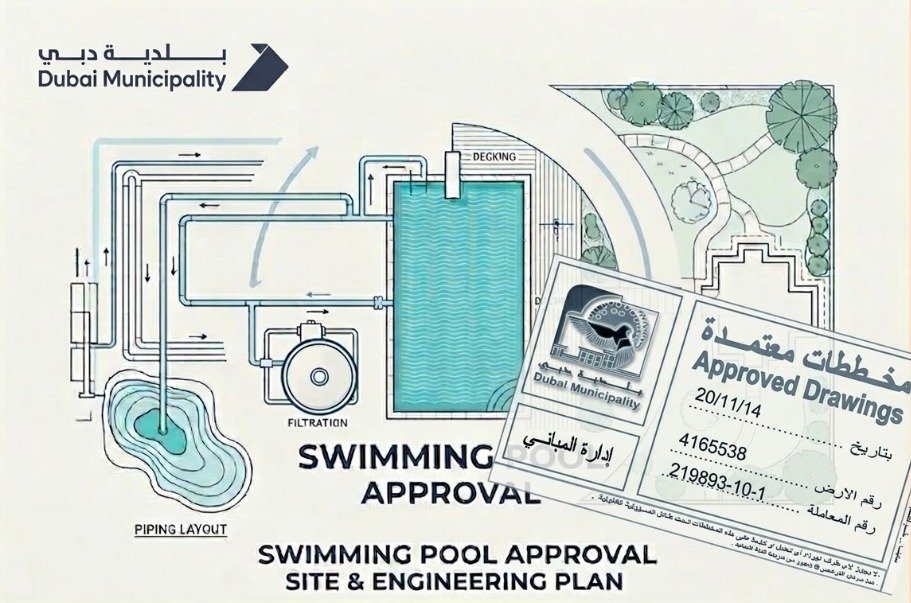
Building a swimming pool in Dubai — whether a private villa pool, a rooftop infinity pool, or a commercial aquatic facility — requires official government approval before any construction begins. Swimming pool approval in Dubai is a structured regulatory process governed primarily by Dubai Municipality (DM) and, depending on your property’s location, the relevant free zone authority or developer authority. Without the proper permits, your project is illegal, subject to demolition orders, and can result in significant financial penalties.
This comprehensive guide covers everything you need to know about the swimming pool approval process in Dubai in 2025 — who needs it, which authorities are involved, the exact steps, requirements, costs, and expert tips to get approved without delays.
What Is Swimming Pool Approval in Dubai?
Swimming pool approval in Dubai refers to the official permits and regulatory clearances required before constructing, modifying, or operating a swimming pool on any property in the emirate. This is not a single permit but a series of coordinated approvals that cover structural design, drainage and plumbing, water treatment systems, electrical safety, and in the case of commercial pools, health and safety compliance.
The primary regulatory authority is Dubai Municipality (DM), which oversees building permits and infrastructure for pools on private and commercial properties. Properties within specific zones may also require approval from:
- Dubai Development Authority (DDA) — for freehold development areas
- Master Developer Authorities — such as EMAAR, Nakheel, or DAMAC for gated communities and developments
- Free Zone Authorities — for commercial pools within free zones
- Dubai Civil Defence (DCD) — for fire safety and emergency systems in commercial aquatic facilities
- Dubai Health Authority (DHA) — for public or semi-public pools (hotels, spas, clubs) where water quality and hygiene standards apply
Key takeaway: Swimming pool approval in Dubai is a multi-authority process. The specific approvals required depend on whether your pool is private or commercial, and where your property is located.
Why Is Swimming Pool Approval Mandatory in Dubai?
Dubai enforces strict swimming pool approval requirements for several important reasons:
- Structural Safety: Pools require deep excavation and significant structural engineering. Unapproved designs may compromise the integrity of surrounding structures, foundations, or neighboring properties.
- Water & Drainage Systems: Pools must connect to approved drainage infrastructure and comply with UAE water conservation and wastewater management regulations.
- Electrical Safety: All underwater lighting, pump systems, and heating installations must be certified to prevent electrocution hazards.
- Public Health Protection: For hotels, clubs, schools, and residential compounds, DHA regulations ensure that pool water is treated, filtered, and tested to prevent waterborne illness.
- Legal Compliance: Operating or building a pool without approval can result in stop-work orders, fines up to AED 50,000 or more, forced removal, and legal liability for any injuries that occur.
- Property & Insurance: Unapproved pools can void your property insurance and create complications when selling your property.
Who Needs Swimming Pool Approval in Dubai?
Swimming pool approval is required for virtually any pool construction or significant modification in Dubai. This includes:
- Homeowners building a private swimming pool in a villa or townhouse
- Hotels, resorts, and serviced apartments with pool facilities
- Residential compounds and gated communities with shared pools
- Schools, gyms, sports clubs, and recreational facilities with competitive or leisure pools
- Spas and wellness centers with hydrotherapy or plunge pools
- Developers and investors installing pools in commercial or mixed-use projects
- Anyone undertaking major renovation, expansion, or retrofitting of an existing pool
Even prefabricated or inflatable semi-permanent pools above a certain size may require notification to Dubai Municipality in some jurisdictions.
Types of Swimming Pools Requiring Approval in Dubai
Private Residential Pools
Individual homeowners in villas, townhouses, or private plots who wish to install a personal swimming pool must obtain building permits from Dubai Municipality (or the relevant developer authority for gated communities). These pools are evaluated for structural design, drainage, electrical systems, and boundary setbacks.
Commercial & Hospitality Pools
Hotels, resorts, serviced apartments, and leisure clubs require a more extensive approval pathway including Dubai Municipality building permits, Dubai Health Authority water quality compliance, and Dubai Civil Defence clearance for safety systems such as depth markers, barriers, and emergency equipment.
Semi-Public Pools (Compounds & Communities)
Shared pools in residential compounds, apartment complexes, and gated communities must meet standards for both structural safety and ongoing operational health compliance, including regular water testing and certified pool management.
Specialized Aquatic Facilities
Olympic pools, water parks, wave pools, and competitive swimming facilities fall under the most rigorous approval processes, often requiring multiple government body sign-offs, specialist engineering reports, and ongoing operational licenses.
Swimming Pool Approval Process in Dubai: Step-by-Step (2025)
Step 1 — Pre-Application & Feasibility Check
Before any drawings are prepared, verify the following with Dubai Municipality or your community’s master developer:
- Zoning regulations and plot usage permissions
- Minimum setback distances from property boundaries (typically 3–5 metres)
- Height and size restrictions if applicable
- Any deed restrictions or HOA rules in your community
- Whether your plot falls under DM jurisdiction or a specific development authority
Step 2 — Appoint a Consultant & Prepare Technical Drawings
Engage a DM-registered civil or structural consultant to prepare the required technical documentation. For most pools, this includes:
- Architectural and structural drawings (pool shape, depth profile, retaining walls)
- Civil and geotechnical reports (particularly for in-ground pools)
- MEP (Mechanical, Electrical & Plumbing) drawings covering filtration, pump systems, drainage, and lighting
- Water treatment system specifications
- Site plan showing the pool’s position relative to the property boundaries
Step 3 — Submit Application via Dubai Municipality (Municipalities Portal)
Applications are submitted through the Dubai Municipality online portal (dm.gov.ae). The submission includes all technical drawings, consultant details, NOC from the property developer (if applicable), and the relevant application fees. Dubai Municipality will assign the application a reference number and begin technical review.
Step 4 — Obtain NOCs from Relevant Authorities
Depending on your pool type and location, you may need No Objection Certificates (NOCs) from:
- Dubai Electricity and Water Authority (DEWA) — for water supply and electrical connections
- Community/Developer Authority — such as EMAAR, Nakheel, or your HOA
- Dubai Civil Defence — for commercial pools with fire safety requirements
- Roads and Transport Authority (RTA) — if construction requires road access modifications
Step 5 — DM Technical Review & Approval
Dubai Municipality’s technical team reviews the submitted drawings and documentation. This stage may involve revision requests if designs do not comply with UAE construction codes or DM standards. Once the review is complete and all comments addressed, DM issues the Building Permit authorising construction to begin.
Step 6 — Construction Phase Inspections
During construction, DM-appointed inspectors will conduct stage inspections, typically at:
- Foundation and excavation stage
- Structural reinforcement and shell stage
- MEP rough-in stage (plumbing, drainage, electrical)
- Final finishing and waterproofing stage
All inspections must pass before proceeding to the next stage. Hiring a DM-registered contractor is mandatory for the construction to be eligible for these inspections.
Step 7 — Final Inspection & Completion Certificate
Upon completion of construction, a final inspection is carried out by DM to verify the pool matches the approved drawings, all safety features are in place, and all systems are operational. For commercial pools, DHA water quality compliance is also verified. Upon passing, a Completion Certificate is issued — this is your legal authorization to use the pool.
Step 8 — Operational Compliance (Commercial Pools)
For hotels, clubs, schools, and facilities where the public accesses the pool, ongoing operational requirements include regular DHA water quality testing, certified lifeguard staffing, display of pool rules and safety signage, and periodic inspections.
Key Requirements for Swimming Pool Approval in Dubai
Design & Technical Standards
- Minimum setback from property boundary: typically 1.5–3 metres (varies by community)
- Depth markings and safety barriers are mandatory for pools deeper than 1.2 metres
- Anti-entrapment drain covers compliant with international safety standards
- Non-slip pool deck surfaces
- Perimeter fencing (minimum 1.2 metres) for pools accessible to children
- Water recirculation and filtration system with certified capacity
- Pool lighting: IP68-rated underwater fixtures only
- Dedicated drainage to avoid discharge to storm drains
Water Quality Standards (DHA — Commercial Pools)
- Chlorine levels: 1–3 ppm (free chlorine)
- pH range: 7.2–7.8
- Turbidity: water clarity must allow visibility of the pool floor
- Microbiological testing: regular lab testing for E. coli, Pseudomonas aeruginosa, and coliforms
- Water turnover rate: minimum 4 hours for leisure pools
Documents Required for Swimming Pool Permit in Dubai
- Completed online application (Dubai Municipality portal)
- Copy of valid title deed / ownership document
- Architectural and structural drawings (stamped by DM-registered consultant)
- MEP drawings and specifications
- Water treatment and filtration system design
- Site plan showing pool position on plot
- NOC from master developer / community authority (if applicable)
- DEWA NOC for water and electrical connections
- Contractor details and valid DM registration certificate
- Insurance certificates (for construction phase)
Swimming Pool Approval Cost in Dubai
Costs for swimming pool permits in Dubai vary based on pool size, type, and the number of NOCs required. Here is a general cost guide:
| Cost Item | Estimated Cost (AED) |
|---|---|
| Dubai Municipality building permit fee | AED 2,000 – 8,000 |
| Structural / civil consultant fees | AED 5,000 – 20,000 |
| MEP consultant and drawings | AED 3,000 – 10,000 |
| DEWA NOC fee | AED 500 – 2,000 |
| Developer / community NOC fee | AED 500 – 5,000 |
| Dubai Civil Defence approval (commercial) | AED 2,000 – 10,000 |
| DHA pool compliance (commercial/hospitality) | AED 1,500 – 5,000 |
| Inspection fees (per visit) | AED 300 – 1,000 |
| Total (private residential pool) | AED 10,000 – 35,000 |
| Total (commercial / hotel pool) | AED 30,000 – 80,000+ |
Note: These figures cover regulatory and consultancy fees only and do not include construction costs. Pool construction in Dubai typically ranges from AED 80,000 for a basic residential pool to AED 500,000+ for large commercial or custom pools.
How Long Does Swimming Pool Approval Take in Dubai?
| Approval Stage | Estimated Time |
|---|---|
| Technical drawing preparation | 2–4 weeks |
| Dubai Municipality permit review | 2–4 weeks |
| NOC collection (DEWA, developer, etc.) | 1–3 weeks |
| Construction phase (residential pool) | 6–12 weeks |
| Final inspection and completion certificate | 1–2 weeks |
| Total end-to-end (private residential) | 12–20 weeks |
| Total end-to-end (commercial / large facility) | 6–12 months |
Incomplete documentation, design non-compliance with UAE building codes, and delays in obtaining community NOCs are the most common causes of timeline overruns.
Common Reasons for Swimming Pool Permit Rejection in Dubai
- Setback violations: Pool positioned too close to property boundaries or neighbouring structures
- Non-compliant drainage design: Discharge routed to storm drains or without approved wastewater management
- Missing MEP drawings: Incomplete electrical, plumbing, or water treatment specifications
- Unregistered contractor or consultant: All professionals must hold valid DM registration
- Failure to obtain community NOC: Required in all gated communities and master developments
- Safety standard gaps: Missing fencing, insufficient depth markers, or non-compliant drain covers
- Incomplete or outdated title deed documentation
Private vs Commercial Pool Approval: Key Differences
| Factor | Private Residential Pool | Commercial / Hotel / Club Pool |
|---|---|---|
| Primary authority | Dubai Municipality | DM + DHA + DCD |
| DHA water quality compliance | Not required | Mandatory |
| Dubai Civil Defence | Usually not required | Mandatory |
| Lifeguard requirement | Not mandatory | Mandatory |
| Ongoing inspections | Rare | Regular (DHA) |
| Water testing frequency | Owner’s discretion | Minimum monthly (DHA) |
| Typical approval cost | AED 10,000 – 35,000 | AED 30,000 – 80,000+ |
Expert Tips to Get Swimming Pool Approval Fast in Dubai
- Hire a DM-registered consultant from day one — unregistered professionals cannot submit plans to Dubai Municipality
- Get your community NOC before starting drawings — many developers have specific design guidelines that will require revisions if not checked in advance
- Run NOC applications in parallel — apply for DEWA, developer, and DM simultaneously where possible to avoid sequential delays
- Use pre-approved pool design templates where available — some master developers (like EMAAR) have standard pool designs that fast-track approval
- Ensure your contractor is DM-registered before signing any contract — unregistered contractors invalidate the permit process
- Address DM revision comments promptly — delays in responding to technical comments are the single biggest cause of slow approvals
- Engage an experienced PRO or approvals specialist who knows the DM portal process and can navigate multi-authority NOC requirements
Swimming Pool Regulations in Dubai: Ongoing Compliance
Approval is not a one-time event for commercial pools. Ongoing compliance obligations in Dubai include:
- Regular DHA water quality testing for all public and semi-public pools
- Annual safety inspections for hotel and resort pools
- Maintenance of pool barriers, signage, and depth markings
- Certified pool operators and lifeguards (commercial facilities)
- Reporting of pool-related incidents to DHA
- Renewal of operational permits as required by the relevant authority
Frequently Asked Questions About Swimming Pool Approval in Dubai
1. Do I need a permit to build a pool in my Dubai villa?
Yes. Any in-ground or permanently installed swimming pool in a Dubai villa requires a building permit from Dubai Municipality (or your community’s master developer authority). Construction without a permit is illegal and can result in demolition orders and fines.
2. Which authority approves swimming pools in Dubai?
The primary authority is Dubai Municipality (DM). Depending on your location and pool type, you may also need clearances from Dubai Electricity and Water Authority (DEWA), the master developer (EMAAR, Nakheel, etc.), Dubai Civil Defence, and Dubai Health Authority (for commercial/public pools).
3. How long does swimming pool approval take in Dubai?
For a private residential pool, the end-to-end process from drawings to completion certificate typically takes 12–20 weeks. Commercial pools and large aquatic facilities can take 6–12 months depending on complexity and the number of approvals required.
4. What is the cost of a swimming pool permit in Dubai?
Permit and consultancy fees for a private residential pool typically range from AED 10,000 to AED 35,000, depending on pool size and the NOCs required. Commercial pool approvals cost AED 30,000 to AED 80,000 or more, excluding construction costs.
5. Can I build a pool without a NOC from my developer?
No. If your property is within a gated community or master development (such as Arabian Ranches, Palm Jumeirah, or any EMAAR/Nakheel project), you must obtain a No Objection Certificate (NOC) from the developer before Dubai Municipality will process your permit. Building without it is a violation of both your community rules and municipal law.
6. Does a hotel pool need DHA approval in Dubai?
Yes. All public and semi-public swimming pools — including hotel pools, club pools, and school pools — must comply with Dubai Health Authority (DHA) water quality and hygiene standards. This includes initial facility compliance, regular water testing, and periodic DHA inspections.
7. What are the pool safety requirements in Dubai?
Key safety requirements include perimeter fencing (minimum 1.2m height) for pools accessible to children, anti-entrapment drain covers, depth markings, non-slip deck surfaces, IP68-rated underwater lighting, and emergency safety equipment. Commercial pools must also have certified lifeguards on duty.
8. Can I modify my existing pool without approval?
Any structural modification — expanding the pool, changing depth, adding a spa or water feature, or altering drainage systems — requires a new building permit from Dubai Municipality. Minor cosmetic changes such as retiling do not typically require a new permit but you should verify with DM or your developer authority.
Conclusion: Getting Swimming Pool Approval in Dubai the Right Way
Swimming pool approval in Dubai is a multi-stage process that requires careful planning, the right professional team, and close coordination with multiple government authorities. Whether you’re building a private villa pool or a large commercial aquatic facility, the approval framework exists to protect structural integrity, safeguard water quality, and ensure the safety of every user.
By engaging registered consultants early, preparing comprehensive documentation, and running NOC applications in parallel, you can significantly reduce your approval timeline and avoid the costly rejections and redesigns that slow down most projects.
Dubai’s regulatory environment for pools is well-structured — once you understand the process, approvals are achievable with the right guidance.
Need help with your swimming pool approval in Dubai? Contact our team of experienced permit consultants for a free initial assessment and timeline estimate.